

Learning how to clone a mushroom on agar for first grow is mostly a buying decision about your sterile setup, not just about agar powder. You are choosing how you will keep tissue clean, how simple your first plates will be, and how much guidance you want while you learn. Your species, batch size, budget, and experience level shape every choice.
Cloning means moving a tiny piece of fresh inner mushroom tissue to agar so it grows out as mycelium with the same traits as the parent. For a first grow, that sounds simple, but drafts, dirty tools, and confusing recipes cause most failures. Updated in November 2026, this framework helps you pick calm, forgiving gear and references that fit a home kitchen. For an overview of the category, browse Sterile Lab Tools.
What Actually Matters
Your Sterile Workspace Comes First
You need still, clean air around your plates more than you need expensive equipment. Most beginners do well with a simple still air box, wiped surfaces, gloves, a mask, and careful hand movement. An isopropyl alcohol spray bottle for sterile work helps you wipe tubs, tables, and gloved hands, but remember isopropyl alcohol is flammable and should be kept away from any open flame, in a well-ventilated area.
Weigh this by your space and batch size. If you only plan to pour and inoculate six to ten plates in a kitchen, a DIY box described in how to build a still air box is usually enough. If you want to run larger batches or work more often, compare airflow options in still air box vs flow hood for budget labs and choose based on budget and how much room you can dedicate.
Agar Simplicity Beats Fancy Formulas at First
For your first clone, pick a basic light malt or potato style agar with very few ingredients and clear kitchen directions. You want plates you can see through easily so white rhizomorphic growth and off-color spots stand out. Pre-poured dishes reduce prep, while pour-your-own bottles teach you sterile pouring but add a learning curve.
Weigh clarity and ease over additives. Charcoal, antibiotics, and rich supplements can mask problems or add steps you do not need yet. Growers commonly report that plain, lightly nutritious plates that stay moist but firm make it easier to spot clean edges for transfers. Choose a recipe that lists home measures, cooling cues, and storage tips in plain language.
Tissue Quality and Transfer Discipline
Your tool set should help you take a tiny piece from the sterile interior of a young, firm mushroom. Oyster, lion’s mane, and shiitake are forgiving starters because they show vigorous growth and clear shapes on agar. You will need a sharp scalpel or blade, flame or alcohol sterilization method, tweezers, and plates you can label and seal without fuss.
Weigh how the gear supports multiple clean attempts. Plan to clone to several plates at once, then move only the cleanest leading edge to fresh plates. Look for tools with comfortable handles, easy-to-wrap sleeves, and dishes that stack stably upside down. Patience here saves grain and substrate later.
Instruction Style That Matches Your Learning Curve
Some guides give you a narrow cloning workflow with photos for each move, while others explain whole mushroom life cycles, spawn, and fruiting. If sterile work feels new, step photos, checklists, and contamination pictures help you act with confidence. If you already fruit kits and want context, broader chapters on spawn and fruiting rooms help you plan ahead.
Weigh depth against overwhelm. A first grow goes better when you can follow one method start to finish without jumping between chapters. Look for troubleshooting that explains what to do with cloudy plates, slow growth, or fuzzy invaders, plus clear notes on when to transfer and when to discard.
To show how those choices play out, here are a few options that show the range from quick-start cloning manuals to deep references for long term study:
This article contains affiliate links. If you buy through one of our links, FungiPop may earn a commission at no extra cost to you. Commissions never influence which products we recommend or how we rank them. Read our Affiliate Disclosure for details.
Quick Picks at a Glance

Prime Growing Gourmet and Medicinal Mushrooms by Paul

Prime Super-Easy Mushroom Growing Recipes for Beginners

Prime Mushroom Cultivation for Beginners

Prime Essential Guide to Cultivating Mushrooms at Home
Prime Ultimate Mushroom Cloning Playbook: Clone
As an Amazon Associate we earn from qualifying purchases. Product prices and availability are accurate as of the date/time indicated.
Pros
- Comprehensive coverage of 31 species makes it a true one-book reference for beginners and experienced growers
- Highly visual format with hundreds of photos and charts simplifies complex sterile technique and cultivation steps
- Covers the full process from lab setup and spawn to harvest, recipes and troubleshooting
- Written by trusted mycologist Paul Stamets with decades of practical cultivation experience
Cons
- Large 592-page format and technical depth can feel overwhelming for complete beginners
- 2000 third edition lacks coverage of newer strains, modern equipment and current suppliers
- Heavy 3-pound paperback works best as a home bench reference rather than a portable field guide
Growing Gourmet and Medicinal Mushrooms by Paul Stamets is a 592-page comprehensive handbook for cultivating 31 gourmet and medicinal species at home or commercially. It serves ecologists, chefs, foragers, home gardeners and commercial growers who want clear, science based instruction in one place.
The book stands out for its precise growth parameters for each species, covering substrates, temperature, humidity and fruiting conditions. Readers get state-of-the-art production methods, lab and grow room construction plans, plus gardening tips and recipes that translate theory into real harvests.
Published by Ten Speed Press in a large illustrated format, the guide includes more than 500 photographs, illustrations and charts plus a 24-page color insert. The layout makes sterile technique, spawn expansion and troubleshooting easy to follow, even across complex multi-stage processes.
The depth that makes it authoritative can intimidate absolute beginners, and some equipment references reflect its 2000 publication date. Its size and weight also make it a bench reference rather than a pocket field guide, so new growers may want to start with one or two species.
Overall, this is the definitive cultivation manual for anyone serious about gourmet and medicinal mushrooms. If you want to build a productive home setup or scale toward commercial growing, this book delivers the knowledge, confidence and visual guidance to succeed.
Publisher: Ten Speed Press, 3rd Revised Edition published October 25, 2000. Language: English with 592 pages of instruction, photos and charts.
ISBN-10: 1580081754, ISBN-13: 978-1580081757. Category focus includes Mushrooms, Landscape and Garden Design books.
Dimensions: 7.52 x 1.54 x 9.02 inches with a weight of 3.05 pounds. Large paperback format designed for bench reference and study.
Pros
- Beginner focused formulas organized by skill level for faster learning
- Covers full cycle from agar to substrate to supplements and fruiting
- High quality illustrations and worksheets improve clarity and planning
- Works with affordable home materials, no pressure cooker or lab gear required
Cons
- 94 page length may feel brief for growers wanting advanced science or commercial scale methods
- Focused on common gourmet types, so less depth for exotic or outdoor log cultivation
- Paperback format requires careful handling in humid grow spaces
Super-Easy Mushroom Growing Recipes for Beginners by Anita Goldwyn is a 94-page practical manual built for first time home growers. It is aimed at anyone frustrated by conflicting online advice who wants simple, repeatable formulas instead of lab theory.
The core value is the 50 recipe system with 10 agar blends, 20 substrates and 20 supplement strategies. Each formula is organized by skill level and matched to varieties like oysters, lion's mane and shiitake, which helps you choose correctly and see faster colonization and healthier flushes.
Design wise, the large 8.5 by 11 inch layout prioritizes clarity with high quality illustrations and visual walkthroughs for agar prep, layering and fruiting. Worksheets and a custom grow plan help you adapt recipes to your climate, tools and goals without guesswork.
The tradeoff is depth. Advanced growers may want more science on sterile technique or commercial scaling, and the focus stays on indoor friendly gourmet types. As a compact paperback, you will want to keep it dry and clean away from your fruiting area.
Overall, this is a strong starter resource if you want confidence and consistency on your first grows. If you need no fuss recipes, clear visuals and practical troubleshooting in one place, this guide delivers real everyday value.
Publisher: Independently published, Publication date: September 19, 2025, Language: English.
Print length: 94 pages, ISBN-13: 979-8262366040, Dimensions: 8.5 x 0.22 x 11 inches.
Series: World of Fungi, Category: Foraging and Biological Sciences, Format: Paperback illustrated guide.
Pros
- Clear, conversational writing that makes cultivation approachable for complete beginners
- Broad coverage of gourmet and medicinal varieties for both indoor and outdoor growing
- Practical DIY projects and fruiting chamber builds for low investment setups
- Includes spawn making, substrate prep, pasteurization and storage guidance in one book
Cons
- Lacks deep scientific detail on sterilization that advanced growers may want
- Focuses on gourmet and medicinal types, with limited coverage of other categories
- Some readers may want more troubleshooting visuals for fixing contamination issues
Mushroom Cultivation for Beginners by Michael York is a 179-page step-by-step guide for growing gourmet and medicinal mushrooms at home, indoors and outdoors. It is written for complete novices who want clear instructions without heavy scientific jargon.
Standout coverage includes spawn production, substrate selection and prep, inoculation, incubation, fruiting and storage. Readers praise the 10 low investment DIY projects and practical builds for Monotubes, Shotgun chambers, Martha setups and grow tents for controlling humidity, light and airflow.
The book is well structured with conversational language, easy to follow stages and comparison guidance on difficulty, substrate, temperature and harvest timing. Its compact 6 by 9 inch paperback format makes it easy to reference in the kitchen, garage or garden workspace.
It is not an advanced mycology manual, so experienced growers may find sterilization and troubleshooting coverage too basic. It also stays focused on edible gourmet and medicinal varieties, so those seeking other types will need additional resources.
Overall, this is an excellent starter manual for anyone wanting a confident first harvest at home. If you want an approachable, project based introduction to mushroom growing, this guide delivers strong value and direction.
Pros
- Covers full skill range from starter kits to grain spawn and fruiting chambers
- Teaches five in-demand gourmet mushrooms for home cooking
- Beginner friendly structure that also supports small market growers
- Kindle edition offers enhanced typesetting, Page Flip and Screen Reader support
Cons
- First published in 2014, so photos and gear references may feel dated
- Large 57.8 MB file size requires extra storage space on older devices
- X-Ray and Word Wise are not enabled, which limits quick reference features
The Essential Guide to Cultivating Mushrooms by Stephen Russell is a practical manual for growing gourmet mushrooms at home. It is aimed at kitchen gardeners, food lovers and beginners curious about sustainable agriculture and small market growing.
The book moves logically from easy mushroom kits to grain spawn, liquid cultures and fruiting chambers. Readers learn to produce shiitake, oyster, lion's mane, maitake and portobello with clear steps that support steady, real world harvests.
As a Kindle edition, it offers 233 pages with enhanced typesetting, Page Flip and Screen Reader support for smooth reading. The layout is instructional and easy to follow, though the large file reflects rich images and detailed guidance.
The main limitation is age, since original publication in 2014 means some equipment and suppliers have changed. Lack of X-Ray and Word Wise also makes it less quick to navigate for readers who rely on those study tools.
Overall, this is a solid, approachable choice for anyone starting home mushroom cultivation. If you want one guide to take you from first kit to confident indoor grower, it delivers lasting value.
Publisher: Storey Publishing, LLC, Publication Date: September 15, 2014, Language: English, Print Length: 233 pages.
Kindle Features: Enhanced typesetting enabled, Screen Reader supported, Page Flip enabled, File size 57.8 MB.
Category: Sustainable Agriculture, Gardening House Plants and Vegetable Gardening, ASIN B00GU2RIRA.
Pros
- Clear plain-English instructions tested by home cultivators, ideal for beginners
- Full-color format helps identify healthy mycelium versus contamination
- Complete system from tissue snip to agar to liquid culture to bulk spawn
- Countertop-friendly approach requires no fancy lab gear or flow hood
- Includes strain library methods and rescue strategies for long-term success
Cons
- Compact 87-page format focuses on practical cloning, not advanced mycology theory
- You must source agar ingredients, jars and basic tools separately
- As a recent release, long-term community results are still emerging
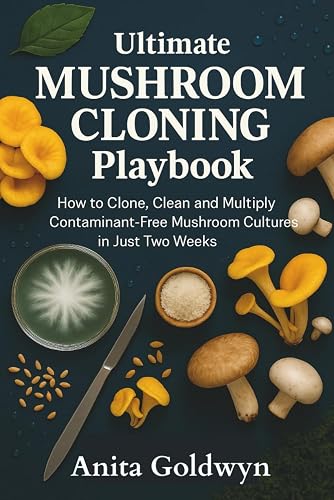
The Ultimate Mushroom Cloning Playbook is an 87-page full-color manual focused on tissue cloning for home growers. It is written for beginners who are tired of spore gamble and want repeatable gourmet results on a single countertop.
Standout coverage includes foolproof cloning workflows, five kitchen-friendly agar recipes like MEA, PDA, ACA and HMA, plus rapid liquid culture methods. DIY sterile techniques such as still-air-box hacks and injection-port shortcuts help keep jars white and vigorous instead of green.
The book uses plain English and step-by-step guidance tested by home-lab cultivators, with real-world case studies for rescuing jars and building strain libraries. The full-color format makes it easier to spot clean mycelium, contamination and healthy colonization progress.
Drawbacks are modest but worth noting. At 87 pages it stays focused on practical cloning rather than deep mycology theory, so advanced growers may outgrow it. You will still need to source agar ingredients, jars and basic tools separately.
Verdict: For countertop growers seeking a clear, low-equipment path from tissue snip to bulk spawn, this playbook is a practical shortcut. If you want clean cultures in two weeks and a freeze-ready strain library, it delivers a confident starting system.
Publisher: Independently published, Publication date: August 10, 2025, Language: English.
Print length: 87 pages, ISBN-13: 979-8297152410, Series: World of Fungi.
Dimensions: 6 x 0.2 x 9 inches, Weight: 6.6 ounces, Format: Full Color Edition.
Category focus: Biotechnology, tissue cloning, agar culture and home mushroom cultivation.
Matching Gear to Your Grow
If you live in an apartment and want to clone one grocery or kit oyster with minimal clutter, keep it narrow. Pair a small still air box, a handful of pre-poured plates, one scalpel, gloves, and alcohol spray with focused instructions. See Ultimate Mushroom Cloning Playbook: How to Clone for a cloning-only workflow, and add Super-Easy Mushroom Growing Recipes for Beginners if you want simple agar and substrate formulas without lab jargon.
If you want your first clone to lead into a full home grow indoors and outdoors, choose references that connect agar to grain, bulk substrate, and fruiting. Mushroom Cultivation for Beginners suits you if you like low investment DIY projects and step order from tissue to harvest. The Essential Guide to Cultivating Mushrooms suits you if you focus on shiitake, oyster, lion’s mane, and maitake and want kit to grain to chamber context.
If you plan to stick with the hobby and build a library, add depth after you master clean transfers. Growing Gourmet and Medicinal Mushrooms is the more premium choice for precise growth parameters and commercial style methods across many species. Use it as a second-stage reference once you can pour, inoculate, and transfer without rushing, and keep your first month focused on one species and one simple agar.
Common Mistakes
Mistake 1: Cloning the outside instead of the inside. Wiping the cap does not make surface tissue sterile. Split a fresh, young stem open with clean hands and lift a rice-grain sized piece from the untouched interior, then close the plate quickly.
Mistake 2: Skipping a proper sterile transfer step. Talking over open plates, reaching over agar, working under a ceiling fan, or reusing a blade without re-sterilizing invites mold and bacteria. Slow your arms inside the box, sterilize between each cut, and keep plates closed except for the seconds you need.
Mistake 3: Pouring plates too thin and holding them open too long. Thin plates dry out and show weak growth, while long open times collect dust. Pour a firm, even layer, let steam clear, store dishes upside down in a clean sleeve, and transfer only the cleanest white edge to a fresh dish.
Who Should Wait or Buy Differently
If you only want to fruit one ready-to-grow kit this month, a full cloning setup is not ideal for you right now. You will get more joy from fresh air, humidity control, and harvest timing than from scalpels and agar. Save cloning gear for your second grow, or share plates and a box with a friend until you know you enjoy sterile work.
Frequently Asked Questions
What part of the mushroom should you clone first?
Choose a young, firm mushroom and take tissue from inside the stem or the thick junction where cap meets stem. That interior has not been exposed to air. Avoid gills, outer skin, and soggy or old fruits because they carry more contaminants.
How many agar plates do you need for a first clone?
Start with more than you think you need, often a small sleeve you can split into initial clones plus cleanup transfers. Inoculate three to four plates from the same fruit, then move clean edges to fresh plates. This gives you backups if one dish shows mold or bacteria.
Do you need a flow hood to clone on agar at home?
No, most first grows succeed with a well-built still air box and calm technique. Keep doors closed, turn off fans, clean surfaces, and move slowly. Consider larger airflow equipment only after you enjoy the process and want higher volume.




Write Your Review
No reviews yet. Be the first to share your experience!