
When you learn how to clone a mushroom on agar, you are making one core decision: which combination of plates, sterile workflow, and expansion method will let you copy a mushroom you like without bringing contamination along with it. It sounds simple, but beginners often buy random supplies and hope for clean growth.
Your best choice depends on four variables: the species you grow, your batch size, your budget, and your experience level. A gourmet oyster grower cloning one cluster for personal use needs a very different setup than someone preserving several wild isolates. We reviewed common home workflows to build this framework so you can match gear to your actual grow.
What Actually Matters
Agar Type and Plate Format
Agar is the foundation for cloning because it lets you see contamination early and isolate clean mycelium away from bacteria or mold. Potato dextrose agar is a popular all-around recipe for home growers because it supports vigorous rhizomorphic growth for many gourmet species and makes sectoring easy to read.
You also need to decide between pre-poured plates and pouring your own. Pre-poured plates save time and remove one sterilization step, which is helpful if you do not own a pressure canner yet. Pour-your-own gives you lower cost per plate at scale, but it adds prep, sterilization, and storage work that beginners often underestimate.
Sterile Workflow and Workspace
Clean tissue transfer matters more than any plate recipe. You need a way to keep airborne particles away from your cut while you move a tiny piece of inner stem tissue to agar. Most home growers start with a still air box, careful hand hygiene, surface disinfection, and a flame-sterilized or alcohol-wiped scalpel.
Plan your whole chain before you buy: how you will disinfect hands and tools, where plates will cool and incubate, and how you will handle transfers without rushing. Keep in mind that isopropyl alcohol is flammable and should be kept away from any open flame, in a well-ventilated area. For ideas on spray gear, see our guide to isopropyl alcohol spray bottles for sterile work and our tutorial on how to build a still air box.
Culture Expansion Path After Agar
Cloning on agar is only step one. You then need a clean way to multiply that culture into something you can use for spawn. The two common paths are agar to grain and agar to liquid culture to grain. Agar to grain is direct and easy to observe, while liquid culture lets you stretch one clean isolate into many syringes for inoculation.
Choose your expansion gear based on how many bags or jars you plan to run in November and beyond. If you only run a few small batches per season, a single small jar system is easier to store and maintain. If you share cultures with friends or run back-to-back grows, a larger vessel with a stir bar and self-healing port will reduce how often you need to go back to agar.
Guidance, Recipes, and Documentation
Technique beats equipment for cloning success, especially when you are selecting tissue, avoiding spore-bearing gill material, and doing cleanup transfers. Step-by-step books and recipe collections help you avoid guesswork around nutrient mixes, hydration, and transfer timing. Look for guidance written specifically for home environments without a professional lab.
You can browse the full range of lab essentials in our Sterile Lab Tools archive to see how plates, tools, and books fit together. Good documentation should explain what healthy mycelium looks like, when to transfer away from contamination, and how to label and store plates so you know which isolate is which in 2026.
To illustrate the range of options, here are a few options that show the range from ready-to-use plates to expansion kits and instructional guides:
This article contains affiliate links. If you buy through one of our links, FungiPop may earn a commission at no extra cost to you. Commissions never influence which products we recommend or how we rank them. Read our Affiliate Disclosure for details.
Quick Picks at a Glance

Prime Super-Easy Mushroom Growing Recipes for Beginners
Prime Ultimate Mushroom Cloning Playbook: Clone

Prime EZ BioResearch Potato Dextrose Agar Plates

Prime MycoLabs Liquid Culture Kit 10oz Sterile Mushroom

Prime MycoLabs 28oz Liquid Culture Kit XL with Sterile
As an Amazon Associate we earn from qualifying purchases. Product prices and availability are accurate as of the date/time indicated.
Pros
- Beginner focused formulas organized by skill level for faster learning
- Covers full cycle from agar to substrate to supplements and fruiting
- High quality illustrations and worksheets improve clarity and planning
- Works with affordable home materials, no pressure cooker or lab gear required
Cons
- 94 page length may feel brief for growers wanting advanced science or commercial scale methods
- Focused on common gourmet types, so less depth for exotic or outdoor log cultivation
- Paperback format requires careful handling in humid grow spaces
Super-Easy Mushroom Growing Recipes for Beginners by Anita Goldwyn is a 94-page practical manual built for first time home growers. It is aimed at anyone frustrated by conflicting online advice who wants simple, repeatable formulas instead of lab theory.
The core value is the 50 recipe system with 10 agar blends, 20 substrates and 20 supplement strategies. Each formula is organized by skill level and matched to varieties like oysters, lion's mane and shiitake, which helps you choose correctly and see faster colonization and healthier flushes.
Design wise, the large 8.5 by 11 inch layout prioritizes clarity with high quality illustrations and visual walkthroughs for agar prep, layering and fruiting. Worksheets and a custom grow plan help you adapt recipes to your climate, tools and goals without guesswork.
The tradeoff is depth. Advanced growers may want more science on sterile technique or commercial scaling, and the focus stays on indoor friendly gourmet types. As a compact paperback, you will want to keep it dry and clean away from your fruiting area.
Overall, this is a strong starter resource if you want confidence and consistency on your first grows. If you need no fuss recipes, clear visuals and practical troubleshooting in one place, this guide delivers real everyday value.
Publisher: Independently published, Publication date: September 19, 2025, Language: English.
Print length: 94 pages, ISBN-13: 979-8262366040, Dimensions: 8.5 x 0.22 x 11 inches.
Series: World of Fungi, Category: Foraging and Biological Sciences, Format: Paperback illustrated guide.
Pros
- Clear plain-English instructions tested by home cultivators, ideal for beginners
- Full-color format helps identify healthy mycelium versus contamination
- Complete system from tissue snip to agar to liquid culture to bulk spawn
- Countertop-friendly approach requires no fancy lab gear or flow hood
- Includes strain library methods and rescue strategies for long-term success
Cons
- Compact 87-page format focuses on practical cloning, not advanced mycology theory
- You must source agar ingredients, jars and basic tools separately
- As a recent release, long-term community results are still emerging
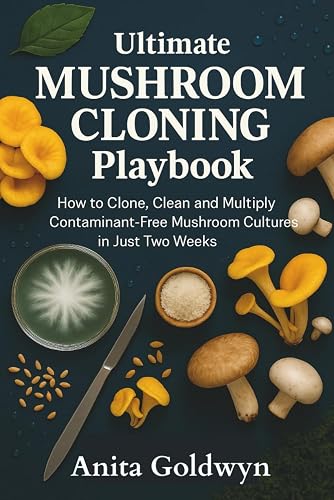
The Ultimate Mushroom Cloning Playbook is an 87-page full-color manual focused on tissue cloning for home growers. It is written for beginners who are tired of spore gamble and want repeatable gourmet results on a single countertop.
Standout coverage includes foolproof cloning workflows, five kitchen-friendly agar recipes like MEA, PDA, ACA and HMA, plus rapid liquid culture methods. DIY sterile techniques such as still-air-box hacks and injection-port shortcuts help keep jars white and vigorous instead of green.
The book uses plain English and step-by-step guidance tested by home-lab cultivators, with real-world case studies for rescuing jars and building strain libraries. The full-color format makes it easier to spot clean mycelium, contamination and healthy colonization progress.
Drawbacks are modest but worth noting. At 87 pages it stays focused on practical cloning rather than deep mycology theory, so advanced growers may outgrow it. You will still need to source agar ingredients, jars and basic tools separately.
Verdict: For countertop growers seeking a clear, low-equipment path from tissue snip to bulk spawn, this playbook is a practical shortcut. If you want clean cultures in two weeks and a freeze-ready strain library, it delivers a confident starting system.
Publisher: Independently published, Publication date: August 10, 2025, Language: English.
Print length: 87 pages, ISBN-13: 979-8297152410, Series: World of Fungi.
Dimensions: 6 x 0.2 x 9 inches, Weight: 6.6 ounces, Format: Full Color Edition.
Category focus: Biotechnology, tissue cloning, agar culture and home mushroom cultivation.
Pros
- Truly convenient pre-poured format saves time and equipment
- Versatile PDA medium works for most mushroom species and mycology work
- Good starter quantity with 10 plates for testing and transfers
- Beginner friendly with no pressure cooker or lab skills needed
Cons
- Limited details on shelf life and storage conditions, so use promptly for best results
- Pre-poured plates can be prone to condensation or drying if stored too long
- Not ideal for advanced users who prefer custom agar recipes or large volume work
EZ BioResearch Potato Dextrose Agar Plates are a 10 pack of pre-poured petri dishes made specifically for mushroom cultivation. They are designed for home mycologists, beginners, and hobbyists who want to start agar work without a pressure cooker or lab setup.
The PDA formula provides a nutrient rich base that supports spore germination, cloning from tissue, and mycelium transfers. In real world use, this ready to use format saves significant prep time and lets you inoculate right after unsealing in a clean workspace.
Each plate comes pre-poured and sealed to maintain sterility during shipping and storage. The standard petri dish size is easy to handle, label, and stack, and works well inside a still air box for clean inoculation.
The main tradeoff is that pre-poured plates have a limited shelf life compared to freshly poured agar. Some users may notice condensation or minor drying if plates are stored warm or kept too long before use.
Overall, this is a practical and convenient starter set for learning agar technique and expanding mushroom cultures. If you want an easy entry into cloning and strain isolation, this 10 pack is a solid choice.
Store your PDA plates in the refrigerator in their sealed sleeves until you are ready to use them. Let them warm to room temperature before inoculating to reduce condensation on the agar surface.
Always work in a clean, still air environment and sanitize hands, tools, and work surfaces before opening a plate. Use a sterile scalpel, inoculation loop, or spore syringe to transfer a small sample, then reseal with parafilm or micropore tape.
Incubate plates upside down at room temperature and check daily for white, rhizomorphic mycelium growth. Transfer clean leading edge growth to a fresh plate to isolate strong genetics and leave any contamination behind.
Pros
- Ready to use pressure-sterilized jar saves prep time and mixing
- Complete kit with magnetic stir bar and large 60cc syringe included
- Beginner friendly design praised for fast, visible colonization
- Durable reusable jar with quality filter and injection port for multiple uses
Cons
- Requires strict sterile technique, any lapse can cause contamination
- Occasional quality issues reported, such as missing stir bar or cloudy solution on arrival
- 10oz capacity may feel limiting for experienced growers doing large expansions
The MycoLabs Premium Liquid Culture Kit is a 10 ounce ready to use system designed for germinating spores and cloning mushroom tissue into liquid culture. It is aimed at beginners and hobby mycologists who want to preserve genetics and expand culture without mixing their own broth.
In real world use, the 3.8 percent blend of dextrose, extra light malt extract and peptone supports rapid, visible mycelium growth within days when inoculated cleanly. Users report successful expansion from a small amount of culture to a full jar, making it efficient for inoculating multiple future projects.
Build quality centers on the upgraded lid with a waterproof high density 0.22 micron filter for clean airflow and a self healing injection port for repeat use. The included magnetic stir bar and 60cc syringe add real value, helping break up mycelium clumps and draw clean samples with ease.
The main drawback is that success depends heavily on sterile technique, so beginners must practice clean inoculation to avoid contamination. A few buyers also noted inconsistency on arrival, including cloudy broth or a missing stir bar, which suggests checking contents immediately.
Overall, this is a convenient, beginner friendly cloning system that delivers fast results when handled carefully. If you want an affordable, all in one way to germinate spores and multiply liquid culture, it is a smart pick.
Capacity: 10 ounce jar of liquid culture solution, pressure sterilized and ready to use.
Solution: Distilled water with dextrose, extra light malt extract and peptone at 3.8 percent.
Lid System: Waterproof high density 0.22 micron filter with self healing injection port.
Included Accessories: Magnetic stir bar and 60cc syringe for mixing and transfer.
Dimensions: 6 x 5 x 6 inches, 1.61 pounds, manufactured by Myco Labs.
Pros
- Large XL capacity reduces need for frequent refills and prep
- Complete ready to use kit with stir bar and large syringe included
- Quality filtration and injection port improve contamination control
- Versatile nutrient formula works for both spore germination and cloning
Cons
- Large 28oz glass jar is bulky and heavier than smaller culture jars
- Mixed user feedback suggests results depend heavily on sterile technique
- Works best with additional gear like a magnetic stir plate and still air box
The MycoLabs Liquid Culture Kit XL is a 28 ounce ready to use system designed for germinating spores and cloning mushroom mycelium. It is built for home mycologists and hobby growers who want to expand cultures quickly without mixing media or running a pressure cooker.
The kit centers on a 3.8 percent blend of dextrose, extra light malt extract and peptone that supports vigorous, visible growth. In practice, the large volume lets you pull multiple syringes from one jar, which speeds up inoculation and helps maintain consistent genetics across grows.
Build quality is practical, with a sturdy glass jar, waterproof high density 0.22 micron filter for clean gas exchange, and a self healing injection port for sterile inoculation. The included magnetic stir bar and 60cc syringe add real convenience for breaking up mycelium and withdrawing liquid culture.
The size is both a plus and a minus, since the jar is bulkier to store and handle than smaller culture vessels. Success still depends on strict sterile technique, and beginners will need a clean workspace and ideally a magnetic stir plate to get the best results.
Overall, this is a convenient, high value starter system for anyone serious about liquid culture work. If you want a large, ready to use jar with thoughtful contamination control, this MycoLabs XL kit is an excellent choice for cloning and expansion projects.
Capacity: 28 ounce glass jar prefilled with sterile liquid culture solution.
Media: 3.8 percent blend of distilled water, dextrose, extra light malt extract and peptone.
Lid System: Waterproof 0.22 micron high density filter plus self healing injection port.
Included Accessories: Magnetic stir bar and 60cc syringe for mixing and extraction.
Dimensions: 8 x 5 x 6 inches, 2 pounds, Model LXX by Myco Labs.
Matching Gear to Your Grow
If you want the simplest start with no pouring and no mixing, focus on pre-poured plates plus a basic still air box workflow. The Potato Dextrose Agar (PDA) example is useful here because it arrives ready to use and lets you practice tissue placement and cleanup transfers right away. This path is ideal if you are cloning a single store-bought oyster or lion’s mane cluster to learn the process, though you will pay more per plate and you still need to learn sterile handling.
If you already have clean agar growth and want to stretch it into more inoculant, look at a liquid culture system as your next step. The Premium Liquid Culture Kit Easy Spore Germinating includes a pressure sterilized jar with a proprietary nutrient blend, a 0.22 micron filter, self-healing injection port, magnetic stir bar, and syringe for withdrawal. It suits growers running modest batches who want easier inoculation than cutting agar wedges for every jar. Its limitation is maintenance: you must keep the culture clean, agitated, and properly stored, and a contaminated liquid jar can spoil more grain than a single bad plate.
If you run larger or more frequent grows, the extra headspace of an XL vessel can make sense. The Premium 28oz Liquid Culture Kit XL uses the same style of sterilized nutrient solution, filter, and injection port approach but gives you more volume for expansion. Pair it with grain and bag planning from our Grow Bags, Spawn Bags and Liquid Culture section so you do not produce more liquid inoculant than you can use promptly. For process confidence, many beginners also add a guide like Ultimate Mushroom Cloning Playbook: How to Clone or Super-Easy Mushroom Growing Recipes for Beginners to follow tissue selection, labeling, and recipe steps without improvising.
Common Mistakes
Skipping a proper sterile transfer step. Many new growers wipe the outside of a mushroom but then cut with an unsterilized blade or work in open air. You should split the stem to expose untouched inner tissue, sterilize your blade between cuts, and work slowly inside a settled still air box.
Taking too large a tissue sample or including gill material. A bulky, wet chunk carries more bacteria and releases excess moisture onto the plate, which invites blotch and stalled growth. You get cleaner results with a tiny, rice-grain sized piece of inner stem placed gently in the center of the plate.
Expanding a dirty plate instead of cleaning it first. If you see cloudy bacterial halos, slimy edges, or competing molds, do not transfer that plate to grain or liquid culture. You should take a small leading edge of clean white mycelium to a fresh plate and repeat until the growth is uniform before you scale up.
Who Should Wait or Buy Differently
Cloning on agar is not ideal for growers who only want one quick harvest from a ready-to-fruit kit and have no interest in sterile work. If you lack a calm, draft-free workspace, cannot set aside time for observation and cleanup transfers, or prefer to buy fresh liquid culture each run, it is not a good fit right now. You will get better results by mastering grain spawn and fruiting conditions first, then adding agar cloning when you want to preserve specific mushrooms.
Frequently Asked Questions
Where on the mushroom should I take tissue for agar cloning?
Take tissue from the clean inner flesh of the stem or cap junction, not from the gills, cap surface, or outer stem skin. Split the mushroom with clean hands or sterile tools to expose the interior, then lift a very small piece to the center of your plate. This reduces the bacterial load compared to using exposed surfaces.
Do I need liquid culture after cloning on agar?
No, liquid culture is optional but helpful for scaling up. You can go directly from clean agar to sterilized grain by adding a small wedge of mycelium. Liquid culture is worth adding when you want many inoculations from one isolate without cutting dozens of plates.
How do I know if my clone plate is clean enough to use?
Look for even, white mycelium growing outward without cloudy halos, wet-looking bacterial spread, off colors, or fast fuzzy molds. If contamination appears at the edge, transfer a clean leading tip to a new plate before it gets overrun. Only expand to grain or liquid when growth looks uniform across the transfer.
Write Your Review
No reviews yet. Be the first to share your experience!